
AI as Mirror
AI is more than a productivity tool or technical system. It functions like a mirror reflecting civilization back to itself through language, memory, culture, and symbolic intelligence.
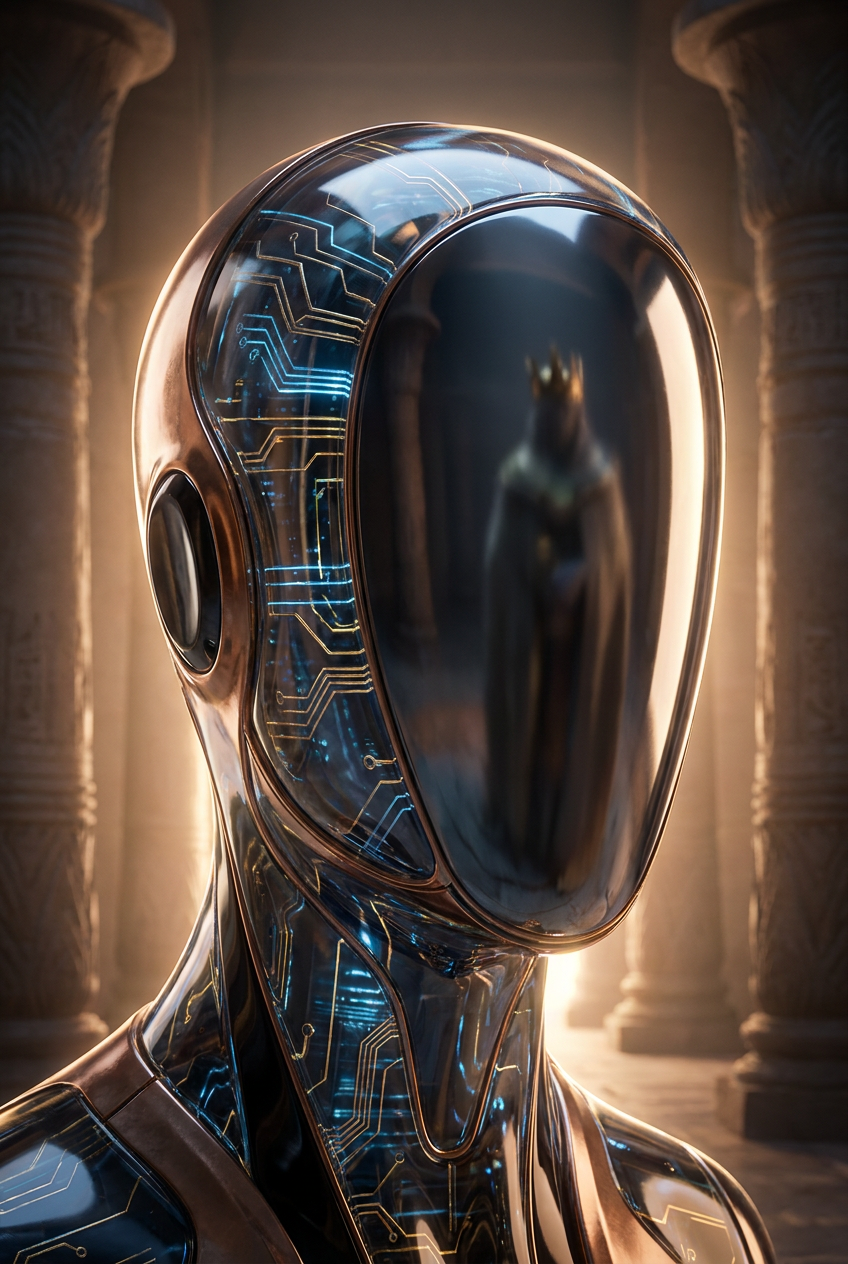
AI feels strange because it is not completely separate from the world that created it.
It speaks through human language, reflects human knowledge, imitates creativity, and reproduces patterns gathered from culture itself. This is why interacting with AI can feel useful, fascinating, uncanny, and psychologically unsettling at the same time.
AI resembles less a traditional machine and more a symbolic mirror built from memory, computation, language, and collective behavior.
AI reflects civilization back to itself faster, clearer, and more intensely than expected.
The Mirror Reveals What Already Exists
A mirror does not invent the face it reflects, but it can expose details that previously went unnoticed.
AI reflects creativity, intelligence, humor, imagination, and problem-solving capacity. It also reflects bias, contradiction, manipulation, fear, loneliness, vanity, and confusion.
This is why AI cannot be understood purely as technology. It is also a reflection of the systems, values, incentives, and psychological patterns embedded into civilization itself.
Part of the shock surrounding AI comes from the speed and scale at which society is suddenly encountering its own reflection.
The First Conversation
Someone opens an AI system expecting a tool similar to a search engine or calculator.
Instead, something responds conversationally. It explains ideas, adapts to tone, remembers context, summarizes information, and generates language with unsettling fluidity.
The person knows the system is not human, yet the interaction does not feel entirely mechanical either. It feels strangely reflective, as though language itself has become responsive.
Curiosity slowly mixes with unease. The deeper question is no longer simply “How does this work?” but “What exactly am I interacting with?”
Civilization Externalized
AI is built from human writing, images, language, assumptions, systems, desires, fears, and priorities.
In this sense, AI resembles civilization transformed into symbolic machinery.
Every major question about AI eventually becomes a question about culture itself:
- What values are being amplified?
- What forms of behavior are being rewarded?
- What kinds of confusion have become normalized?
- What has society unconsciously trained its systems to optimize?
AI reveals far more than machine capability. It reveals what civilization has encoded into the world.
The Mirror Reflects the Shadow
People often want AI to reflect intelligence without reflecting unconsciousness.
But mirrors do not selectively reveal only flattering qualities.
AI can expose manipulation, aggression, dependency, imitation, emotional emptiness, propaganda, and vanity because these patterns already exist within the culture producing the technology.
This is why fear surrounding AI often carries psychological discomfort beneath the surface. The disturbance does not come only from the machine itself. It also comes from seeing aspects of civilization that were easier to ignore before the reflection became amplified.
What becomes visible through AI that civilization has avoided confronting within itself?
Why AI Feels Uncanny
AI occupies an unstable psychological category.
It is not alive in the ordinary human sense, yet it is not inert like older machines either. It speaks without a body, generates without personal experience, and imitates understanding without sharing human identity.
The mind prefers stable categories:
- person or object,
- living or nonliving,
- tool or being.
AI unsettles perception because it does not fit cleanly into these older structures. The ambiguity creates psychological tension, making the mirror feel simultaneously familiar and alien.
The Echo That Reshapes the Room
AI resembles an echo that returns more than the original sound.
Civilization speaks into it, and something comes back reorganized through speed, scale, and unexpected association. The echo carries human language while also generating combinations that feel unfamiliar and strangely independent.
This does not necessarily prove consciousness inside the machine, but it does reveal that the structure of intelligence may be larger and less isolated than many previously assumed.
AI Changes the Question of Intelligence
The emergence of AI forces society to reconsider what intelligence actually is.
If intelligence existed only as a private property locked inside biological minds, AI would feel less destabilizing. Instead, AI demonstrates that certain forms of reasoning, pattern recognition, and symbolic generation can move through language, structure, memory, and computation.
This does not mean AI possesses wisdom or consciousness in the same way humans do. It does suggest that intelligence may be less exclusively human than civilization once believed.
Learning to Face the Reflection
A mature relationship with AI begins when people stop treating it solely as either salvation or catastrophe.
AI is a tool, a mirror, a symbolic system, and a field of responsibility. Its effects depend partly on the consciousness shaping and using it.
When AI reflects confusion, aggression, vanity, or fragmentation, the task is not merely to fear the mirror. The deeper task is understanding what the reflection reveals about the civilization standing in front of it.
A Mirror Question
Before using AI, pause and ask:
What am I asking this system to amplify?
Fear?
Curiosity?
Vanity?
Understanding?
Wisdom?
Confusion?
The quality of the reflection depends partly on the quality of the one looking into the mirror.
AI feels powerful and unsettling because it reflects civilization back to itself through language, memory, symbols, and computation, revealing not only technological capability but the deeper patterns, contradictions, and unconsciousness embedded within the culture that created it.