
The Attention Economy and the Collapse of Consciousness
Modern civilization no longer competes primarily for labor, land, or information. It competes for attention. The consequence is not merely distraction, but the gradual fragmentation of awareness itself.
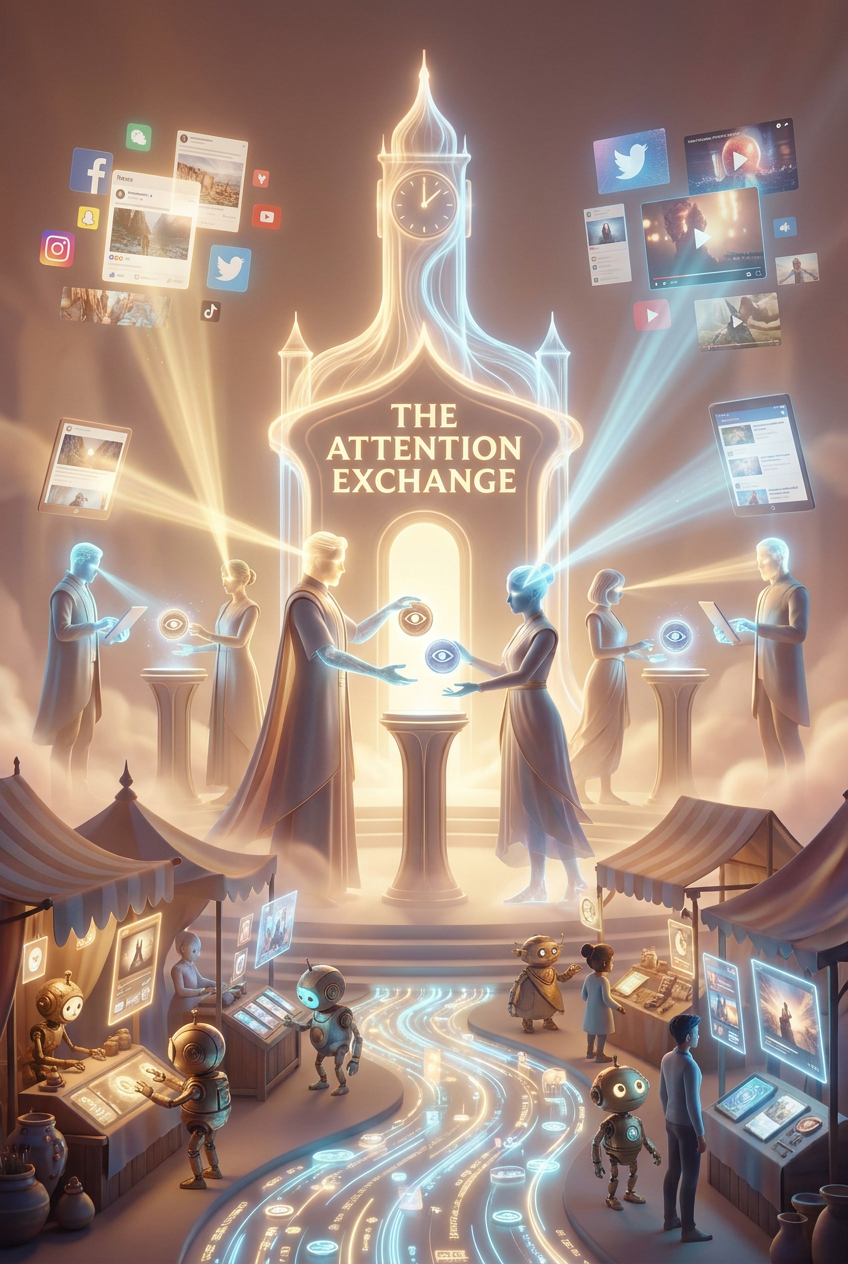
This article explores the attention economy as more than a technological phenomenon. Modern systems increasingly compete for awareness itself, and the continuous fragmentation of attention gradually reshapes perception, emotion, identity, and the nervous system.
The attention economy does not simply consume time; it conditions awareness toward fragmentation, reactivity, and loss of inner stillness.
Attention Became the Primary Resource
Earlier civilizations extracted land, labor, coal, oil, and industrial power. Modern digital civilization increasingly extracts attention.
Platforms compete continuously to capture awareness for as long as possible. Notifications interrupt concentration, feeds refresh endlessly, algorithms optimize for emotional reaction, and content becomes faster, louder, shorter, and more stimulating.
This transformation affects society psychologically because attention is not merely another economic resource. Attention is the mechanism through which reality is experienced.
Attention Shapes Inner Reality
What people repeatedly focus on gradually reshapes perception itself.
Attention influences memory, emotion, identity, desire, nervous system conditioning, and interpretation of reality. A person continuously exposed to outrage begins perceiving the world through outrage. A person continuously exposed to acceleration gradually loses tolerance for silence, slowness, and uninterrupted presence.
The attention economy becomes powerful because it conditions awareness internally while appearing to entertain externally.
Continuous Stimulation Rewires the Nervous System
Human nervous systems evolved within environments containing rhythm, silence, seasons, physical movement, and natural pacing.
Digital environments operate differently. Constant novelty, infinite scrolling, short-form content loops, perpetual stimulation, and emotional activation keep the nervous system in continuous partial engagement.
Many people now experience mental fatigue, restlessness, fragmented attention, emotional reactivity, and difficulty remaining present without stimulation. The transformation is subtle because it happens gradually. Over time, fragmentation begins feeling normal.
The Fragmented Mirror
Imagine trying to see your reflection inside a mirror shattered into thousands of moving pieces.
Each fragment reveals something partial, but no stable image remains long enough for recognition. Modern awareness increasingly resembles this condition. Thoughts interrupt thoughts, emotions interrupt reflection, and attention interrupts itself before integration can occur.
The problem is no longer distraction alone. It is the gradual loss of continuity within awareness itself.
The Economy of Addiction
Most digital systems are designed primarily for engagement maximization rather than human flourishing.
Fear keeps attention. Novelty keeps attention. Conflict keeps attention. Validation keeps attention. Algorithms gradually learn which emotional triggers capture each individual nervous system most effectively.
People eventually begin confusing stimulation with meaning. Yet stimulation creates activation, while meaning creates depth. The attention economy often amplifies activation while weakening depth.
How often do you experience silence without reaching for stimulation?
Information Overload and Meaning Collapse
Modern people often assume more information automatically creates more understanding.
But beyond a certain threshold, excessive information produces confusion instead of clarity. Individuals consume enormous amounts of news, opinions, videos, predictions, emotional signals, and arguments while feeling increasingly disoriented.
Meaning requires integration. Information without integration becomes psychological noise. Eventually the nervous system loses sensitivity to the difference between signal and distraction, truth and manipulation, wisdom and stimulation.
The result is cognitive exhaustion.
A Simple Modern Scene
A person wakes up and immediately checks their phone.
Messages, news, notifications, social feeds, videos, and emails begin flooding attention before the nervous system fully settles into conscious presence. The day continues similarly. Moments that once contained stillness become filled automatically while waiting in line, eating, walking, resting, or falling asleep.
The person may appear connected to everything externally while gradually losing connection internally.
AI and Attention Amplification
Artificial intelligence intensifies the attention economy dramatically.
AI systems increasingly optimize personalization, behavioral targeting, emotional engagement, prediction, and content generation in real time. For the first time in history, civilization is creating systems capable of learning continuously how to capture and shape human attention at planetary scale.
This is not inherently evil. But it is powerful, and power without awareness creates danger.
What happens when civilization loses the ability to direct attention consciously?
Deep Awareness Requires Stability
Reflection requires slowness. Understanding requires integration. Wisdom requires sustained attention.
A fragmented mind struggles to perceive deeper patterns because awareness resets constantly before integration can occur. This is why contemplative traditions across cultures valued silence, solitude, breath, nature, meditation, and disciplined attention.
Not because stimulation is inherently wrong, but because clarity requires periods of stabilization.
Reclaiming Attention
The solution is not necessarily rejecting technology completely.
Technology itself is not the core problem. The issue is unconscious relationship with technology. Human beings must learn when to slow down, disconnect, reflect, remain present, and protect awareness from continuous fragmentation.
Attention matters because whatever repeatedly occupies awareness gradually shapes identity itself. Reclaiming attention means reclaiming participation in inner life.
Notice how your nervous system feels after extended exposure to fragmented digital stimulation.
Then notice the difference after:
walking in nature,
reading slowly,
having uninterrupted conversation,
or sitting quietly without external input.
Awareness changes under different attentional conditions.
The attention economy is ultimately competing for awareness itself. Every interruption fragments continuity, every algorithm subtly shapes perception, and every moment of unconscious stimulation weakens inner stillness; yet every act of conscious attention restores coherence, presence, and the possibility of reclaiming the mind from fragmentation.